Field
Commercial roofing in Northwest Arkansas
Flat roof installations, coatings, emergency repairs and maintenance plans for warehouses, retail stores, office buildings and industrial facilities.
Chapter 01
Why flat roofs fail at the seams and the drains
A flat roof is not truly flat. It is a very shallow slope that has to carry every rainfall to a drain, and the failures follow the water. Ponding collects where the slope runs out, a membrane ages faster under standing water, and the first leak usually shows at a seam or a drain rather than in the open field.
Punctures are the other common cause. Service crews, foot traffic, dropped tools and storm debris can cut a membrane that looks intact from the roof hatch. Flashing pulled loose at a parapet wall or around a rooftop unit lets water in behind the membrane, where it travels sideways before it ever shows inside.
This is the Field station on the path of water. The building below is what the roof hands down to, so drainage is the first thing worth checking.
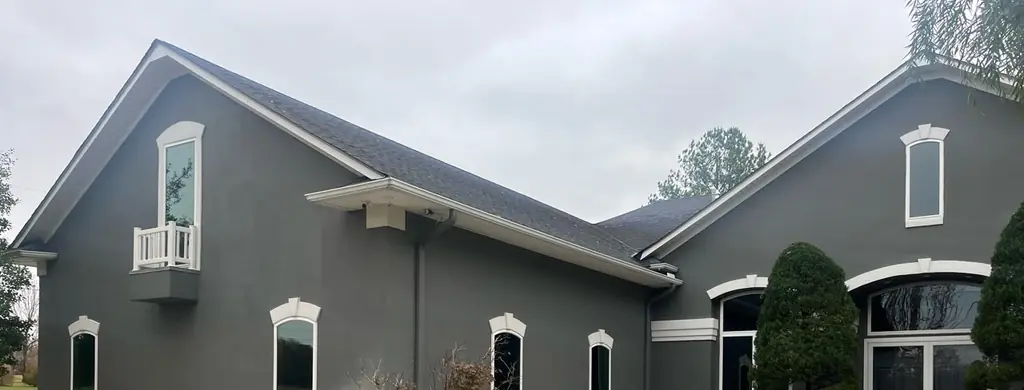
Roofline, gutters and a downspout on a dark grey stucco home
The systems on the roof, and what a coating does
Commercial buildings carry a handful of common systems: TPO, EPDM, metal, modified bitumen and built-up roofs. Iron Shield works with these on warehouses, retail stores, office buildings and industrial facilities, and does flat roof installations, commercial roof coatings, emergency repairs and maintenance plans.
A coating is a liquid layer applied over an existing roof. It is worth knowing when it is the wrong answer. A coating can seal small cracks, but it cannot fix wet insulation, a failed seam or a membrane that has come apart. That is what an inspection is for.
Iron Shield states over 40 years of combined experience in roofing and restoration, and its crews are licensed and insured.
Chapter 03
A maintenance habit that protects the building
A roof asks for attention on a schedule, not only when it leaks.
By the time water shows on a ceiling it has usually been getting in for a long while, and the insulation under the membrane has been soaking it up. Wet insulation cannot be coated over. It has to come out.
That is why Iron Shield offers maintenance plans for commercial roofs. The five habits in the second list further down are the ones its own advice keeps returning to.
Iron Shield is licensed and insured. Call (479) 337-4766.

Coatings and upkeep
Coatings and upkeep, in two short lists.
Pitched residential roofs behave differently, and you can read about them under Roofing. For a flat roof on a business, the quickest next step is to send the details and ask for a free estimate.
What a coating gives a roof
- Energy efficiency
- A reflective coating sends sunlight back and helps keep the building cooler.
- UV and weather protection
- A barrier against sun, wind and rain for the system underneath.
- A longer working life
- It can put off the day a full replacement is needed.
- Sealed small cracks
- Hairline gaps close up before they turn into leaks.
- Less waste
- Keeping a sound roof in service means less material in a dumpster.
Five habits for a flat roof
- Inspect in spring and again in fall, especially on flat roofs.
- Keep drains and gutters clear so water does not stand.
- Check for punctures and debris after storms or heavy foot traffic.
- Seal cracks and flashing early, before they leak.
- Write down every inspection and repair.
Before you call
Questions building owners ask about roofs.
Which roof systems does Iron Shield work on?
The common commercial systems: TPO, EPDM, metal, modified bitumen and built-up roofs. The right one depends on the size of the building, its design and how the roof drains, and the team can recommend a system for your property.
What should I look for to know a flat roof is in trouble?
Leaks, ponding water, cracked or blistered membrane, and flashing that has lifted or split. Catching any of these early usually keeps the repair small.
How often should a commercial roof be inspected?
Twice a year, in spring and fall, and after severe weather. Estimates are free, so you can have the roof looked at before deciding anything.